
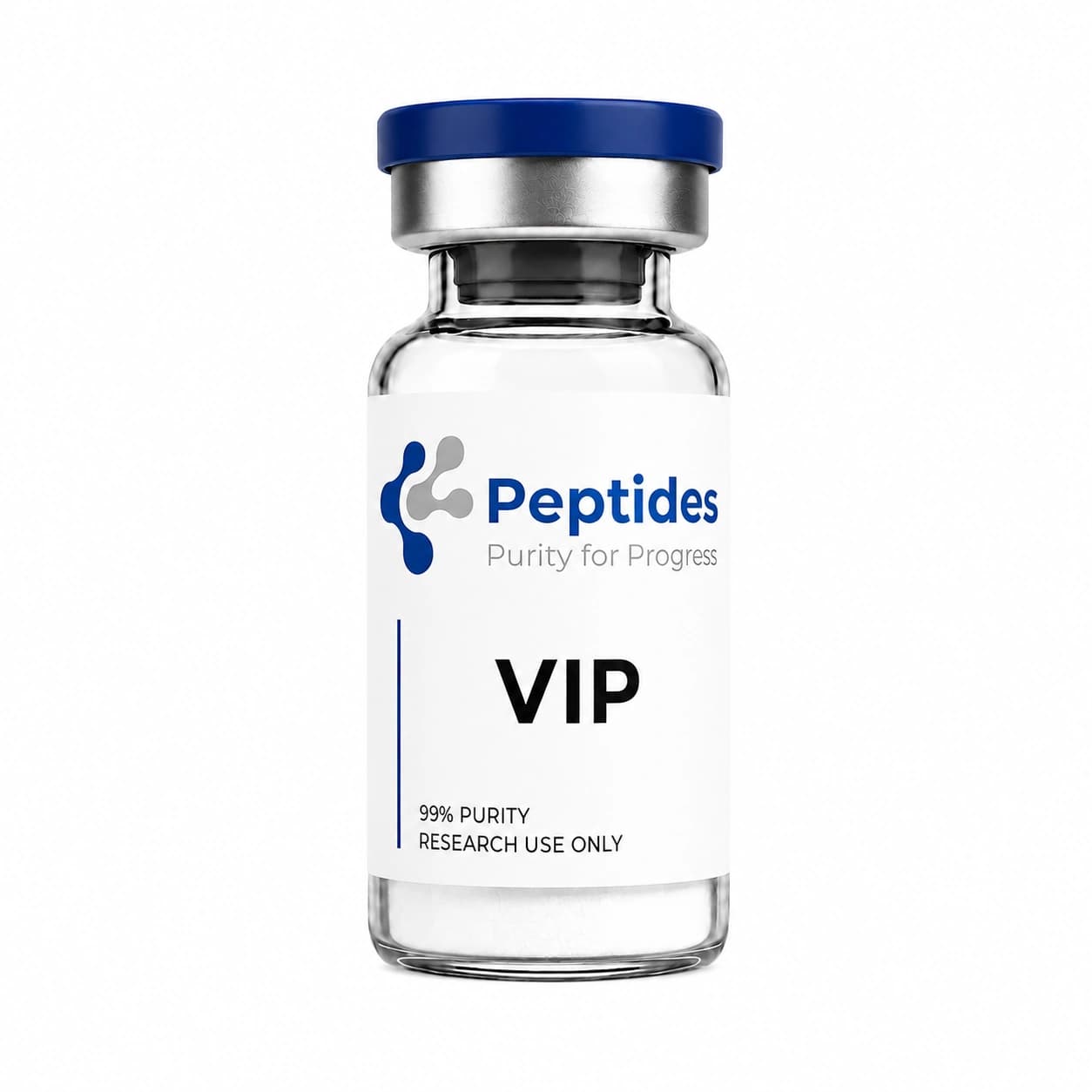
Buy VIP (Vasoactive Intestinal Peptide) Research Peptide
VIP is available as a lyophilised powder, independently HPLC and MS-UPLC tested to ≥98% purity.
Buy VIP (Vasoactive Intestinal Peptide) Research Peptide
VIP is available as a lyophilised powder, independently HPLC and MS-UPLC tested to ≥98% purity.
HPLC Verified
≥98% purity
Lyophilised
Powder format
Express Shipping
Cold-chain included
COA Available
Every batch
HPLC Verified
≥98% purity
Lyophilised
Powder format
Express Shipping
Cold-chain included
COA Available
Every batch
Same or Next Day Dispatch
Order before 12pm GMT for same-day dispatch; after 12pm ships next business day
Same or Next Day Dispatch
Order before 12pm GMT for same-day dispatch; after 12pm ships next business day
What is VIP (Vasoactive Intestinal Peptide)?
A synthetic 28-amino-acid neuropeptide first isolated from intestine, also known as vasoactive intestinal peptide, VIP is studied across nervous, digestive and immune systems. Research focuses on its signalling through two widely distributed receptors and its role in body-clock biology.
- Studied for its signalling through the VPAC1 and VPAC2 receptors.
- Investigated in research models for circadian-clock biology.
- Examined for its activity across nervous, digestive and immune-cell models.
- Used as a research tool to study neuropeptide signalling.
For research use only. Not intended for human use.
Spanning 28 amino acids and engaging two distinct Class B G protein-coupled receptors, Vasoactive Intestinal Peptide has been a cornerstone ligand in neuropeptide signalling research since its characterisation in the early 1970s. VIP (CAS 37221-79-7) carries the molecular formula C147H237N43O43S and a molecular weight of 3326.82 g/mol. As an endogenous agonist at both VPAC1 and VPAC2 receptors, VIP activates adenylyl cyclase-coupled cAMP signalling cascades. Produced via solid-phase peptide synthesis.
In vitro studies using isolated immune cell populations have investigated VIP-mediated cAMP accumulation and downstream PKA-CREB signalling in macrophages and dendritic cells. In vivo rodent models have examined the role of exogenous Vasoactive Intestinal Peptide in suprachiasmatic nucleus circuit function, investigating its influence on neuronal synchronisation.
Manufactured in a quality-controlled laboratory to a guaranteed purity of 98% or above. Every batch undergoes independent third-party testing using HPLC and MS-UPLC analysis before dispatch. Vials are vacuum sealed and stored in a temperature-controlled, monitored cold storage system. A batch-specific Certificate of Analysis is available on request.
Sold strictly for in vitro research purposes only. Not for human consumption. Intended for use by qualified researchers in laboratory settings only.
Scientific Review

Scientific review
Dr. Cristina Cosi
Scientific Contributor and Reviewer
Currently under review
View credentials ›What Researchers Say
Sign in to leave a reviewNo reviews yet. Be the first to share your research experience.
Frequently Asked Questions
Related Compounds
Kisspeptin
Mol. Wt.
1,302.44 g/mol
Purity
≥98%
CAS No.
374683-17-7
PT-141 (Bremelanotide)
Mol. Wt.
1,025.17 g/mol
Purity
≥98%
CAS No.
189691-06-3
PTD-DBM
Mol. Wt.
3,082.64 g/mol
Purity
≥98%
CAS No.
N/A (chimeric research peptide)
Oxytocin
Mol. Wt.
1,007.19 g/mol
Purity
≥98%
CAS No.
50-56-6
ACTH 1-39
Mol. Wt.
4,541.10 g/mol
Purity
≥98%
CAS No.
9002-60-2
TB-500
Mol. Wt.
4963.4 g/mol
Purity
≥99%
CAS No.
885340-08-9
Select Size
Quality Guaranteed
Every batch is HPLC-tested to ≥98% purity. Certificate of Analysis and SDS available on request.