
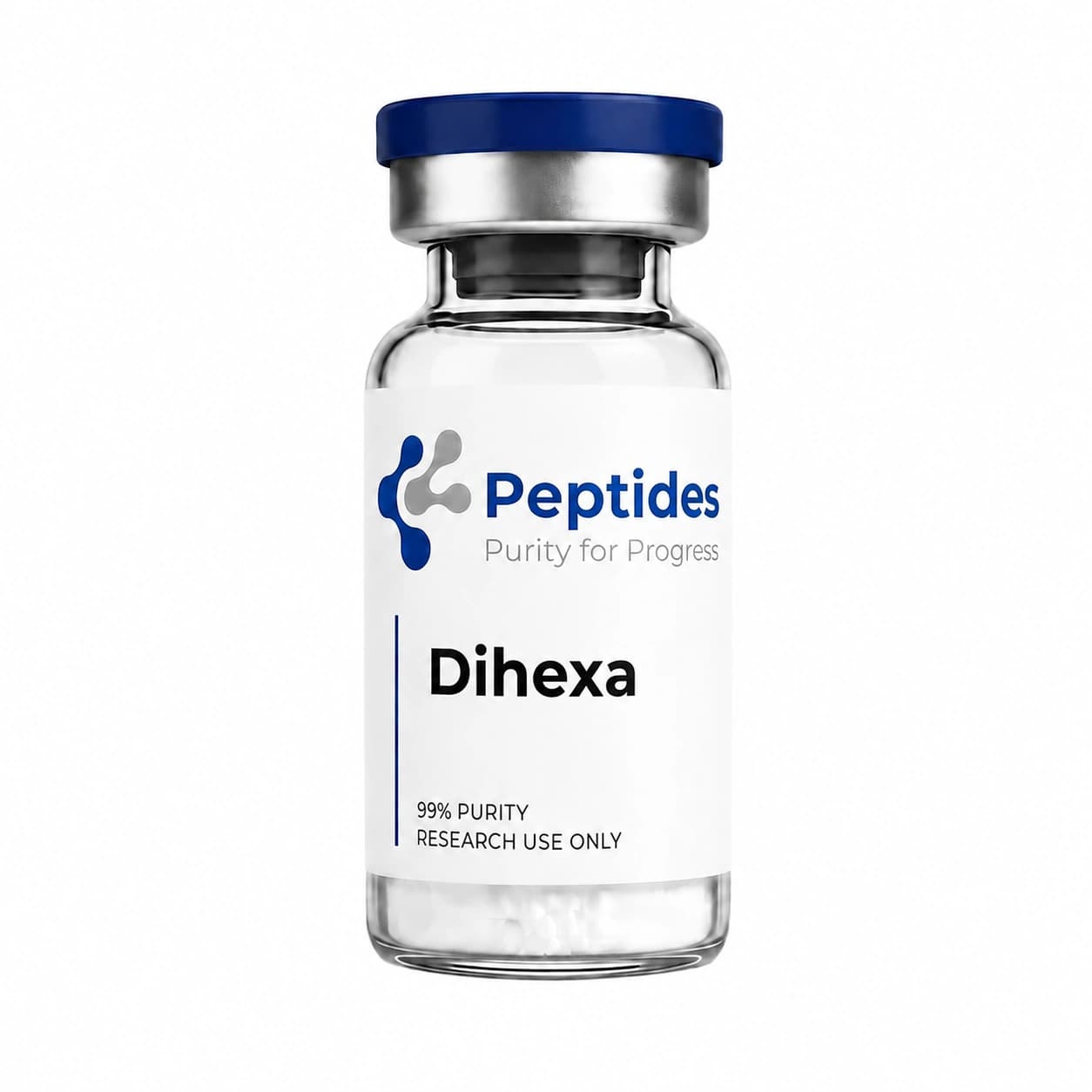
Buy Dihexa Research Peptide
Dihexa is available as a lyophilised powder, independently HPLC and MS-UPLC tested to ≥98% purity.
Buy Dihexa Research Peptide
Dihexa is available as a lyophilised powder, independently HPLC and MS-UPLC tested to ≥98% purity.
HPLC Verified
≥98% purity
Lyophilised
Powder format
Express Shipping
Cold-chain included
COA Available
Every batch
HPLC Verified
≥98% purity
Lyophilised
Powder format
Express Shipping
Cold-chain included
COA Available
Every batch
Same or Next Day Dispatch
Order before 12pm GMT for same-day dispatch; after 12pm ships next business day
Same or Next Day Dispatch
Order before 12pm GMT for same-day dispatch; after 12pm ships next business day
What is Dihexa?
A synthetic peptide derived from the hormone fragment angiotensin IV and engineered for durability, also known as PNB-0408, Dihexa is studied for its effects on memory and learning. Research focuses on its action on the hepatocyte growth factor signalling system tied to connections between brain cells.
- Studied for its activity on the hepatocyte growth factor (HGF) signalling system.
- Investigated in research models for synaptogenesis pathways.
- Examined for its metabolic stability versus parent fragments.
- Used as a research tool to study HGF/c-Met signalling in neurons.
For research use only. Not intended for human use.
Rational design based on the angiotensin IV pharmacophore produced Dihexa, a stable peptidomimetic analogue that has become a key research tool in hepatocyte growth factor (HGF)/c-Met receptor signalling research. Also designated PNB-0408, has the molecular formula C21H35N3O4 and a molecular weight of 393.52 g/mol. Unlike endogenous angiotensin IV, Dihexa incorporates an N-terminal hexanoic acid cap and a C-terminal aminohexanoic amide extension that confer protease resistance. Produced via solid-phase peptide synthesis.
In vitro studies using c-Met-expressing cell lines have examined whether PNB-0408 acts as an allosteric modulator of c-Met dimerisation, investigating receptor autophosphorylation and downstream PI3K/Akt signalling in the presence of subactivating HGF concentrations. In vivo rodent models have explored the CNS distribution of PNB-0408 following peripheral administration, examining blood-brain barrier penetration and central c-Met receptor occupancy.
Manufactured in a quality-controlled laboratory to a guaranteed purity of 98% or above. Every batch undergoes independent third-party testing using HPLC and MS-UPLC analysis before dispatch. Vials are vacuum sealed and stored in a temperature-controlled, monitored cold storage system. A batch-specific Certificate of Analysis is available on request.
Sold strictly for in vitro research purposes only. Not for human consumption. Intended for use by qualified researchers in laboratory settings only.
Scientific Review

Scientific review
Dr. Cristina Cosi
Scientific Contributor and Reviewer
Currently under review
View credentials ›What Researchers Say
Sign in to leave a reviewNo reviews yet. Be the first to share your research experience.
Frequently Asked Questions
Related Compounds
Semax
Mol. Wt.
813.92 g/mol
Purity
≥98%
CAS No.
80714-61-0
Selank
Mol. Wt.
751.88 g/mol
Purity
≥98%
CAS No.
129954-34-3
P21 (P021)
Mol. Wt.
~500–600 g/mol
Purity
≥98%
CAS No.
N/A (novel research peptide)
Orexin B
Mol. Wt.
~2,937.59 g/mol
Purity
≥98%
CAS No.
205120-58-9
DNSP-11
Mol. Wt.
1,180.27 g/mol
Purity
≥98%
CAS No.
N/A (novel research peptide)
Humanin
Mol. Wt.
2,806.15 g/mol
Purity
≥98%
CAS No.
330936-69-1
Select Size
Quality Guaranteed
Every batch is HPLC-tested to ≥98% purity. Certificate of Analysis and SDS available on request.