
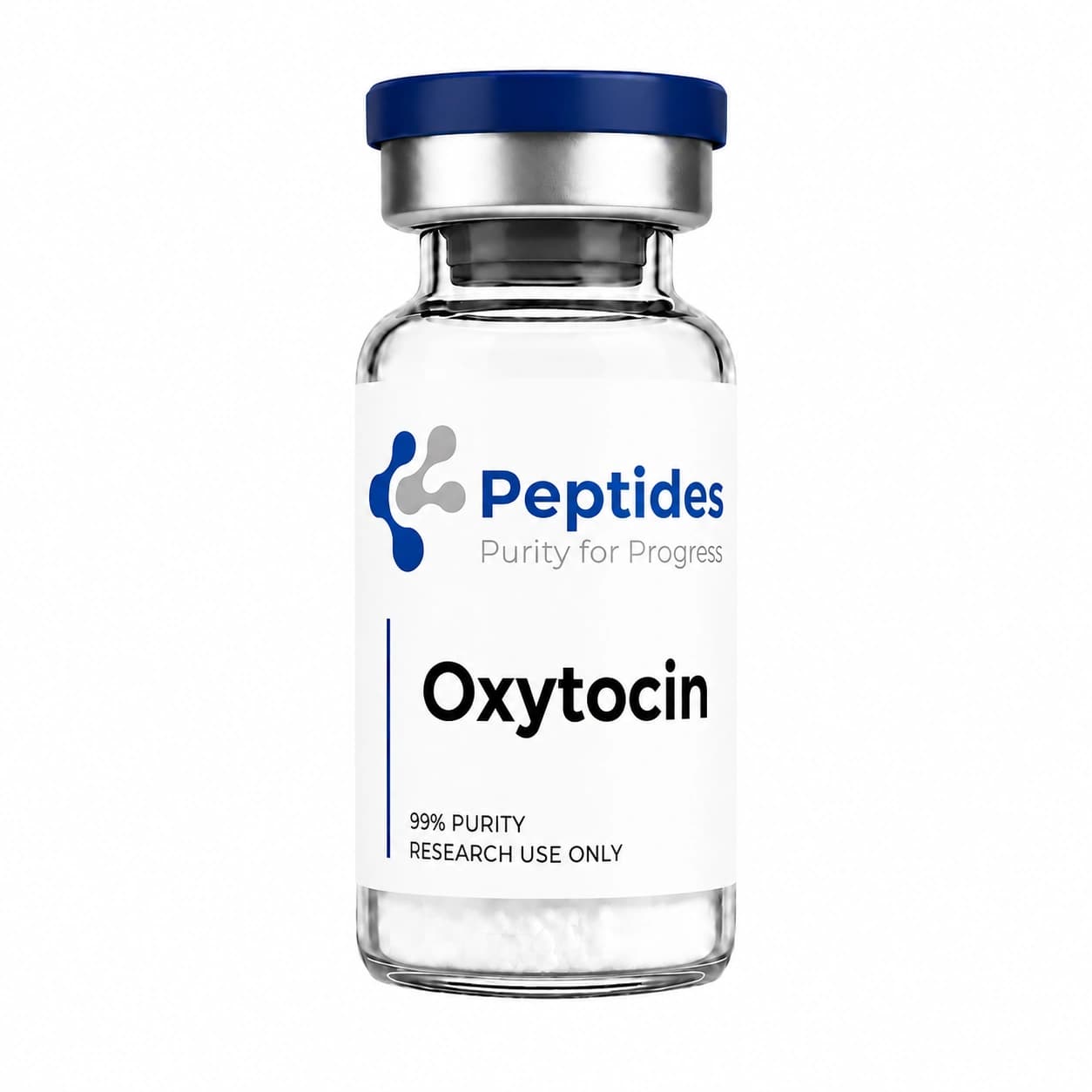
Buy Oxytocin Research Peptide
Oxytocin is available as a lyophilised powder, independently HPLC and MS-UPLC tested to ≥98% purity.
Buy Oxytocin Research Peptide
Oxytocin is available as a lyophilised powder, independently HPLC and MS-UPLC tested to ≥98% purity.
HPLC Verified
≥98% purity
Lyophilised
Powder format
Express Shipping
Cold-chain included
COA Available
Every batch
HPLC Verified
≥98% purity
Lyophilised
Powder format
Express Shipping
Cold-chain included
COA Available
Every batch
Same or Next Day Dispatch
Order before 12pm GMT for same-day dispatch; after 12pm ships next business day
Same or Next Day Dispatch
Order before 12pm GMT for same-day dispatch; after 12pm ships next business day
What is Oxytocin?
A synthetic cyclic nine-amino-acid neurohormone and one of the most studied signalling peptides in biology, Oxytocin is studied across neuroscience, reproduction and behaviour. Research focuses on its signalling through the oxytocin receptor in the brain and many peripheral tissues.
- Studied for its role in social and affiliative behaviour in animal models.
- Investigated for its signalling through the oxytocin receptor (OXTR) in the brain and peripheral tissues.
- Examined for its effects on stress-response and reward pathways in rodent studies.
- Used as a model peptide in neuroendocrine and reproductive-tissue research.
For research use only. Not intended for human use.
As a cyclic nonapeptide containing an internal disulphide bridge between cysteine residues at positions 1 and 6, Oxytocin has served as a structural archetype in neurohypophyseal peptide research for over half a century. Also designated OXT (CAS 50-56-6), it carries the molecular formula C₄₃H₆₆N₁₂O₁₂S₂ and a molecular weight of 1007.19 g/mol. Produced via solid-phase peptide synthesis, it acts at the oxytocin receptor (OXTR), a Gq-coupled GPCR.
In the rat brain, oxytocinergic projections from neurons of the parvocellular nucleus (PVN) and of the supraoptic nucleus (SON) of the hypothalamus release oxytocin (OXY) in brain areas related to the reward circuitry, ventral tegmental area (VTA) and nucleus accumbens, to the stress circuitry, hippocampus, amygdala and PVN, and to the maternal functions circuitry, medial preoptic area and olfactory bulb. These projections are believed to be critical for appropriate social interactions. Evidence in rodents demonstrated that OXY induces prosocial behaviour through direct effects on the dopaminergic neurons of the VTA, providing insight into how social interactions can generate rewarding experiences.[1] Oxytocin administered centrally in rodent models reduced stress effects on hippocampal synaptic plasticity and memory via acting on oxytocin receptors and regulating ERK activity.[2] OXY receptor mRNA and autoradiographic binding are higher in the VTA and mPOA of postpartum rats, and inhibition by site-specific OXY receptor antagonist in either brain area impairs caregiving in recently parturient dams.[3]
Manufactured in a quality-controlled, ISO9001 certified laboratory to a guaranteed purity of 98% or above. Every batch undergoes independent third-party testing using HPLC and MS-UPLC analysis before dispatch. Vials are vacuum sealed and stored in a temperature-controlled, monitored cold storage system. A batch-specific Certificate of Analysis is available on request.
Sold strictly for in vitro research purposes only. Not for human consumption. Intended for use by qualified researchers in laboratory settings only.
References
Hung LW, Neuner S, Polepalli JS, Beier KT, Wright M, Walsh JJ, Lewis EM, Luo L, Deisseroth K, Dölen G, Malenka RC. Gating of social reward by oxytocin in the ventral tegmental area. Science. 2017;357(6358):1406-1411.
PubMed PMID: 28963257
Lee SY, Park SH, Chung C, Kim JJ, Choi SY, Han JS. Oxytocin Protects Hippocampal Memory and Plasticity from Uncontrollable Stress. Sci Rep. 2015;5:18540.
PubMed PMID: 26688325
Pedersen CA, Caldwell JD, Walker C, Ayers G, Mason GA. Oxytocin activates the postpartum onset of rat maternal behavior in the ventral tegmental and medial preoptic areas. Behav Neurosci. 1994;108(6):1163-1171.
PubMed PMID: 7893408
Scientific Review

Scientific review
Dr. Cristina Cosi
Scientific Contributor and Reviewer
Reviewed for scientific accuracy, 18 June 2026
View credentials ›What Researchers Say
Sign in to leave a reviewNo reviews yet. Be the first to share your research experience.
Frequently Asked Questions
Related Compounds
Kisspeptin
Mol. Wt.
1,302.44 g/mol
Purity
≥98%
CAS No.
374683-17-7
PT-141 (Bremelanotide)
Mol. Wt.
1,025.17 g/mol
Purity
≥98%
CAS No.
189691-06-3
PTD-DBM
Mol. Wt.
3,082.64 g/mol
Purity
≥98%
CAS No.
N/A (chimeric research peptide)
VIP (Vasoactive Intestinal Peptide)
Mol. Wt.
3,326.83 g/mol
Purity
≥98%
CAS No.
37221-79-7
TB-500
Mol. Wt.
4963.4 g/mol
Purity
≥99%
CAS No.
885340-08-9
Sermorelin
Mol. Wt.
3,357.93 g/mol
Purity
≥98%
CAS No.
86168-78-7
Select Size
Quality Guaranteed
Every batch is HPLC-tested to ≥98% purity. Certificate of Analysis and SDS available on request.